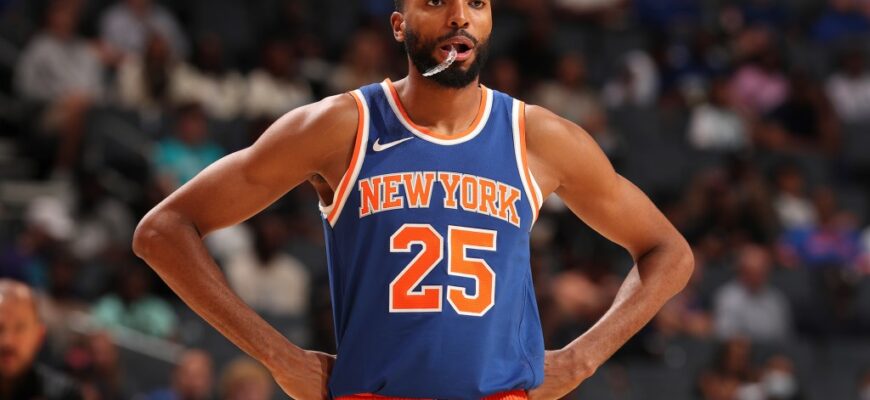
Mikal Bridges has finalized a four-year, $150 million contract extension with the New York Knicks. This agreement, reported by ESPN on Thursday, has been anticipated for over a year, ever since the Knicks acquired Bridges in a significant trade with the Brooklyn Nets last offseason.
Following Bridges` acquisition, the Knicks also secured a long-term contract extension with their key point guard, Jalen Brunson, a team-friendly deal significantly below market value. The ongoing expectation has been that Bridges, a former Villanova teammate of Brunson`s, would follow suit. This collective effort aims to preserve the championship-contending roster the Knicks have meticulously assembled over the past few seasons.
With Bridges now secured, all five starters from the Knicks` regular season last year—a season that saw them reach their first Eastern Conference Finals in 25 years—are under contract for at least the next two seasons, with an additional option year for some.
While retaining these players has been costly, both Bridges and the Knicks made important concessions to finalize this deal. So, what are the implications of Bridges` extension for New York, both in the immediate and long term?
Navigating the Second Apron
The Knicks have demonstrated exceptional financial management, successfully avoiding the NBA`s second luxury tax apron for two consecutive seasons. However, given their current contract structures, it was always probable that New York would exceed the second apron during the 2026-27 and 2027-28 seasons, assuming they maintain their core roster.
Depending on their draft position and whether Guerschon Yabusele exercises his player option, New York had an estimated $45 million to $55 million room below the second apron. If Bridges` new deal begins at its maximum possible salary, he would account for approximately $33.5 million in the 2026-27 season. However, at that point, the Knicks would only have nine players under contract, or eight if Yabusele opts out, with Mitchell Robinson not among them. Should Robinson be re-signed and the roster fully assembled, New York is projected to significantly surpass the second apron.
This financial trajectory has always been part of the Knicks` strategic plan, and they are well-prepared for it. With their core roster established, the second apron`s roster-building restrictions will have less impact on them compared to teams still in a rebuilding phase. The most severe penalty of the second apron—a future first-round pick dropping to No. 30—only applies after a team spends three years above the second apron within a five-year period. However, the Knicks` financial setup positions them to effectively reset their roster after the 2027-28 season, coinciding with the expiration of Karl-Anthony Towns` contract.
The likely strategy is to aggressively pursue a championship over the next three seasons before potentially scaling back below the second apron thereafter. Bridges` new contract aligns perfectly with this objective. As New York has not yet finalized a new agreement with Robinson, they retain flexibility if a roster adjustment becomes necessary. If Robinson`s long-term health becomes a concern, the Knicks could opt to let him go next summer to remain below the second apron, providing additional room for roster improvements. (At that juncture, their 2033 first-round pick would become available for trade, provided they stay below the second apron.)
Regardless of these specifics, the Knicks` roster appears largely set for the foreseeable future. If they believe their current squad is championship-caliber, they can commit fully for the next three seasons. If not, they still maintain a degree of financial flexibility. Few teams manage their finances as skillfully as the Knicks, and this contract seamlessly integrates into their planned structure.
Bridges` Financial Concessions
While Bridges` market value is not as high as Brunson`s, their financial decisions shared a common theme. Both Brunson and Bridges were initially on contracts significantly below their market value and were eligible for only 40% raises in the first year of a new deal, due to veteran extension limitations based on prior salary. Extending early meant limiting their potential earnings. If Brunson had waited until 2025 free agency, he almost certainly would have signed a five-year maximum contract starting at 30% of the salary cap. Instead, he accepted less. It is highly improbable that Bridges would have commanded a 30% max as a 2026 free agent. Now, we will never know, as he chose to extend early, adhering to that 40% raise parameter.
Furthermore, Bridges did not even take the maximum amount he was eligible for in an extension. Had he extended at 40% with 8% annual raises, as permitted, his extension would have totaled approximately $156.1 million. While $150 million is not as significant a discount as Brunson provided, it is still beneficial. In the complex world of luxury tax aprons, every dollar counts.
The financial discount wasn`t the only advantage Bridges offered the Knicks. He also provided them with a timing benefit. When a player receives a first-year raise of at least 20% or annual raises exceeding 5% (as Bridges did in this extension), they become ineligible for trade for six months. High-profile players sometimes intentionally delay signing such extensions until late in the summer to effectively prevent a trade. For example, Lauri Markkanen extended on August 7, 2024, because the trade deadline was February 6, 2025, creating a de facto no-trade clause.
Bridges, however, chose not to wait. He was eligible to extend as early as July 6. If he had waited until August 6, he would have essentially established a one-year no-trade clause, given that the upcoming trade deadline is February 5, 2026. By signing on July 31, he will become trade-eligible at the end of January, providing New York a window of a few days before the deadline to move him if they choose.
Considering the Knicks` long-standing interest in Giannis Antetokounmpo, these few days could prove critical. If New York aims to pursue him during the season using Bridges as a trade asset, they will now have that capability.
Knicks` Significant Concessions
A key reason Bridges was willing to grant the Knicks a few days of trade flexibility was that New York included a trade kicker in his contract. While the Knicks gain the ability to trade Bridges closer to the deadline, they, in turn, committed to paying him a substantial bonus if he is traded at any point during his contract. This arrangement makes sense for Bridges. He specifically wanted to play for the Knicks since his time in Brooklyn. He was prepared to offer them a slight discount, but if they were to send him to an undesirable team, he would want to recoup the money he forewent. The trade kicker ensures he will.
However, the trade kicker wasn`t the only significant concession Bridges secured from the Knicks. He also locked in a player option for the 2029-30 season. While the Knicks have shown a recent willingness to include player options, it has not historically been the franchise`s preferred approach.
Jalen Brunson has a player option because he not only accepted a steep discount but is undeniably the franchise player; the Knicks had no leverage to deny him one. OG Anunoby and Guerschon Yabusele also have player options, but they had negotiating power as free agents. Typically, the Knicks operate differently, often convincing many players to sign deals with team options or non-guarantees, unlike many other teams. Josh Hart, for example, has one at the end of his current contract.
This player option could be immensely valuable for Bridges. If he remains an effective player in 2029, heading into his age-33 season, he will be able to seek one final, lucrative payday a year early, without concerns about a potential decline by 2030. It`s impossible to predict the market four summers from now, but given the league`s high demand for versatile wing players and the current rising salary cap environment, Bridges should be well-positioned to capitalize when that time arrives, provided he remains healthy (he has an impressive track record of never missing an NBA game).
Both the Knicks and Bridges made genuine sacrifices to finalize this deal. Considering their shared season, this compromise is sensible for both parties.
Although New York advanced to the Eastern Conference Finals, Bridges` individual performance was somewhat underwhelming. Had he performed as expected, he likely could have commanded the full $156.1 million maximum and signed later in August, which would have shielded him from a midseason trade. Given his inconsistent season, a contract like this represents an appropriate middle ground. Perhaps the Knicks could have negotiated a slightly larger discount if they had delayed the signing. Conversely, Bridges might have secured the full maximum without the player option. Instead, this agreement perfectly embodies the concept of a compromise.